Pages

Tuesday, June 12, 2012

Transition Toolbox—Organization & Central Coherence


In Do2Learn's blog, Transition Toolbox—How Does ASD Affect Transitions?, we told you we would be addressing core features that have a significant impact on the transition process. Today we will discuss organization and central coherence. We hope that allowing these peeks into our new product are peaking your interest!

Some individuals with Autism Spectrum Disorder (ASD) show significant difficulty with sequential organization and planning of multi-step tasks. Shifting of focus to use new or unexpected information in a task may pose a problem for some. Many seem to process information in a limited set of categories and struggle to integrate new information into existing mental frameworks. This has led to a theory of central coherence suggesting that many individuals with ASD have difficulty seeing the ‘big picture.’ New information, especially around meaning, context, and social interaction, can be missed or misinterpreted. Generalization of skills is a consistent challenge for many individuals with ASD. This difficulty applying skills previously learned under one condition to new conditions implies problems shifting focus and using a concept or rule when certain features of a setting or condition change.
There continues to be controversy confirming a central coherence deficit as a primary descriptor of ASD. A less debatable observation is that certain individuals with ASD have difficulty deciding how to use new information in social and cognitive problem-solving situations. For an individual with ASD, figuring out what a new event means and how to ‘fit’ it into life can be confusing. These common difficulties for individuals with ASD in assessing new information, in weighing the ‘pros’ and cons’ in decision making, and in planning the steps to complete a task require transition team members to adjust their thinking. If individuals with ASD have problems assessing how to apply their strengths and weaknesses in vocational and social situations, in determining their goals or in planning a course of action, there will be challenges in self-determination and self-advocacy.
In transition planning, the prominence of inventory assessments to evaluate strengths and interests is obvious. Yet the difficulties related to organization and central coherence often make inventory assessments absurdly ineffective in identifying directions for transition planning for individuals with ASD. Assessments of preferences and strengths related to career goals must be individualized.
Building self-determination skills is feasible and important.
  • First, provide multiple experiences in vocational and community environments. Without the opportunity to practice and experience work activities, work environments, and the social contexts of those work settings, individuals with ASD may confront failure or frustration in future settings.

  • Second, provide visual supports to help the individual self-evaluate and compare experiences so that the individual can define preferences and self-advocate to the highest degree possible. These visual supports should be provided within a systematic framework of direct instruction, using established behavioral principles, that assures application and generalization of skills.
  • Providing opportunities for hands-on exploration of work and academic experience must be followed by individualized and systematic self-assessment of the experience to support self-advocacy in career planning.
To address cognitive differences in ASD and to assist self-determination, the instructor must provide multiple experiences and visual supports provided within a framework of direct instruction. This is one primary goal of the JobTIPS Transition Toolbox.
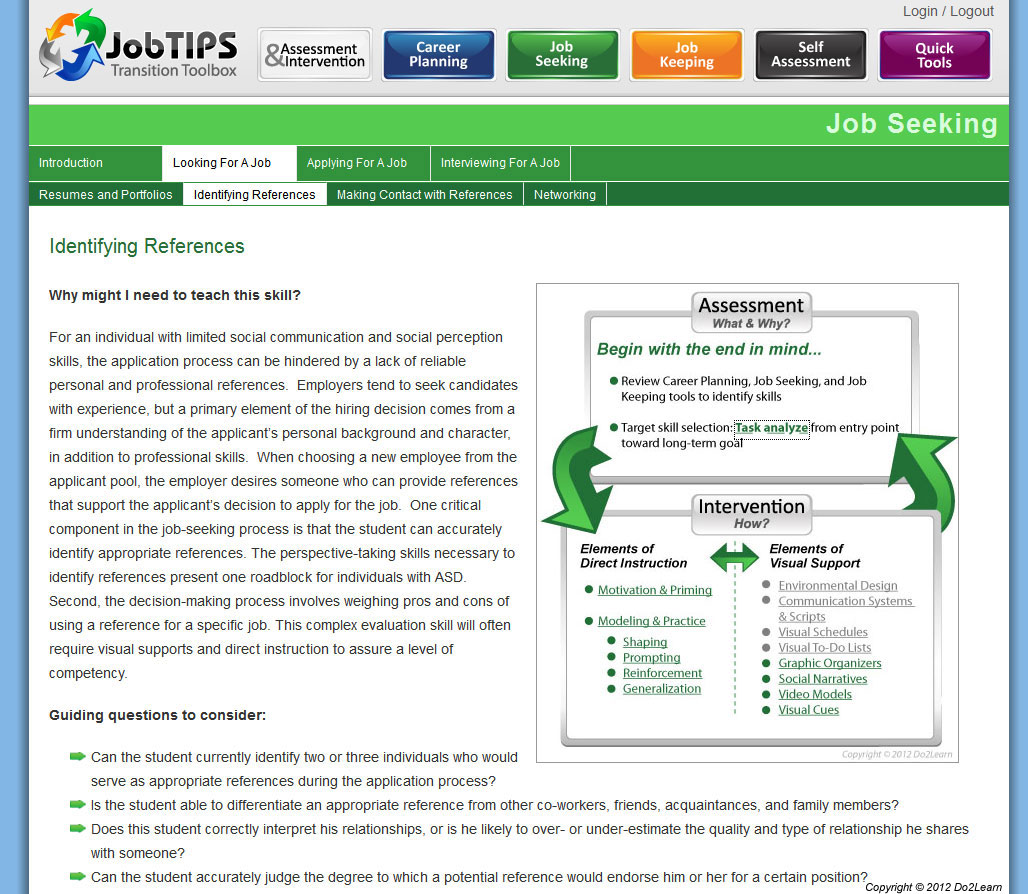
An example of what Transition Toolbox will look like.


Sunday, June 10, 2012

It Is About What You Learn In Kindergarten


Yesterday we celebrated the graduation of one of Kaitlin's friends from High School. WTG class of 2012!

What was so special about this celebration was that it was a gathering of teachers, parents, and friends who had all started out together in preschool/kindergarten. The graduate himself requested this. Yes, he has Autism, but let me assure you that is just an aside, because having Autism has never once gotten in his way of achieving any dream or goal. So the goal for this gathering was a reunion of sorts and thankfully all the pieces fell into place. Oh, guess what...you know all those stories about individuals with Autism not being social? Umm, well, I think if you had been with us yesterday you would have seen those stories completely dispelled! In fact it may not have been much different from any other gathering you might have peeked in on. I take that back, it would have been a lot more fun and you would have felt much more comfortable. Here are some snippets of conversation you would have heard...
  • “Miss Kat can you do those windshield wipers like you used to do in bus loop when we were little?”
  • “Can you believe we both used to wear Harry Potter glasses?”
  • “Oh no, Miss Laurie and Miss Carolyn didn't just take us on a train. We went all the way to Rocky Mount!”
  • “Don't worry *****,  he is on his way. I just spoke with his dad and they are almost here.” Said in response to a non-verbal individual who was communicating that he wanted to see another guest really bad.
  • “I am taking classes at Wake Tech and looking for a job. Your job sounds nice.”
  • “Make sure everyone gets some cake now and I will share my lemonade too”
  • “I graduate next year. I am going to have a party like this too, okay?”
I could go on and on, but my point is that this group of young men and women socialized together and enjoyed each others company yesterday in a way that was so typical, yet they had to work so hard to get to that point. The teachers that started this are to be applauded for all the hard work they put into these young people. Most of these young people had very little language in preschool/kindergarten and with a lot of patience, structure, and love these teachers taught these kids communication, manners, self-advocacy and more. Yep, all that in kindergarten! All with shapes, stories, songs, snacks, dances, and playground time!

What you learn in kindergarten makes a HUGE difference, so make it count!!
June 9th 2012


Wednesday, June 6, 2012

Making Your Life Easier—Checklists, Calendars, and Forms


Having structure in your child/student's life makes your life easier! You know it, I know it and we covered it in our blog A Schedule? She's Two back in January 2012. What you may not know is that Do2Learn has free printable resources available to you.

I recommend that you print off copies of the ones you find the most useful and keep them handy so you can fill them in as needed. Of course you can save them on your computer and fill them in with text or pictures and then print, but sometimes plain old fashioned handwriting works best and is quickest. These forms are just a few of the ones that are utilized in Do2Learn's Make-A-Schedule Program.

  • Daily form with 10 lines—10 activities can written and then checked off or a sticker earned as each one is completed.
  • 1 inch daily form—this is really good as a homework chart
  • 1 inch weekly form—this form can have a picture or activity listed down the side and then checked off or a sticker earned and used for one week.

  • weekly form with 10 lines—this form is helpful in keeping users organized and independent for a whole week.
  • weekly form with 20 lines—this form offers more room and can be used in the same way as the above form for chores, homework, etc.
  • calendar form—the calendar allows for more forward planning and keeping track of long term assignments, appointments, vacation days, etc.
  • 1 inch blank form—make your own schedule
  • 2 inch blank form—make your own schedule using larger images
We would love to hear how you find these organizational forms helpful! Drop us a line.


Monday, June 4, 2012

Transition Toolbox—How Does ASD Affect Transitions?


There are a number of reasons why many individuals with Autism Spectrum Disorder (ASD) struggle to successfully transition from high school to the workforce. It may be difficult for some individuals with ASD to accurately identify how their strengths and needs align with potential vocational areas. Moreover, identifying how to apply the unique strengths of individuals with ASD within mainstream post-secondary education and work environments may pose a challenge for the transition team as well.

In addition, differences in social communication skills can make job situations difficult for someone on the spectrum. Interviewing, talking to a supervisor, making small talk with co-workers, and asking for help can be challenging. Because social rules and norms do not always come naturally to individuals with ASD, the process of getting a job and sustaining employment can be very confusing. Coping with stress and anxiety in the workplace is crucial to success yet often a major challenge for individuals with ASD.

The range of vocational abilities, of interaction skills, and of cognitive problem-solving skills in individuals with a diagnosis of ASD is remarkably broad. Yet there are certain common elements that, if carefully considered, can support effective transition planning even in this diverse group of learners. These common elements, or core features, are pivotal in how the Transition Toolbox is organized and presented. Depending on the individual with ASD, certain core features will be more prominent than others.
(We invite you to follow our blog by email to be sure to get the latest information regarding JobTIPS Transition Toolbox and other great Do2Learn educational information.)

It is important to understand the core features that have a significant impact on the transition process. We will address these core features in future Transition Toolbox blogs.


Thursday, May 31, 2012

Teaching and Learning Shapes—Why?


Because it's fun! Of course we all know that part, but did you know that learning shapes help children identify letters and help them with reading and writing later on? Letters are made up of circles, lines, and triangles. Look at the parts of a triangle in k, v and w or the circles in b, q, and p, also the lines of a square in l, q, k and so on. By learning to draw basic shapes children will have the beginning skills for pre-writing! Who knew you could have so much fun teaching and learning?

Wait, there is more, and this is going to be stating a bit of the obvious. Learning shapes at an early age exposes children to the world of math as well. The world of angles, geometry, numbers, puzzles, etc. is now open simply because you are teaching something so fun!

Do2Learn offers several ideas on how to begin to teach shapes and make it fun. We hope you have a great time with these activities.

  • Shape People—make a shape person with triangles, circles or squares. (click on link for complete instructions)

  • The Shape Book—Students learn shapes by decorating each shape with various textures. (click on link for complete instructions)


  • Shape Tracing—Practice drawing shapes. (click on link for printouts)


Wednesday, May 23, 2012

Do2Learn JobTIPS—Making Midtown News


What a pleasure it was to answer a call last week from Chelsea Kellner. Chelsea is a reporter from the Midtown Raleigh News and she was interested in talking to someone from Do2Learn about the recent report regarding the findings that 1 in 3 young adults with Autism have little to no paid job experience or college schooling after high school. 

Chelsea had heard about JobTIPS and wanted to know more and we were happy to oblige. So in today's Midtown Raleigh News (front page too!) there is a wonderful article titled “Job-hunt help for adults with autism, Raleigh-based site offers free services”.

Please check out a few of our previous blogs about JobTIPS.


Tuesday, May 22, 2012

Transition Toolbox—Transition 101


Transition services as defined by the Individuals with Disabilities Education Act (IDEA) are intended to help youth with disabilities make the transition from the world of secondary school to the world of adulthood. A good transition plan should consider the individual’s strengths as well as needs in determining the best fit for the individual in terms of vocation, living arrangements, post-secondary education, etc.
It is important to understand that when the individual leaves public secondary school, the Americans with Disabilities Act (ADA), not IDEA, becomes the law that guides access to rights and services for the adult. Inherent in ADA is the expectation that the individual will advocate for his/her own needs.
  • Can s/he evaluate and state his/her strengths and preferences?
  • Should s/he disclose anything about his unique learning and performance needs? 
  • Can s/he effectively self-disclose about his needs and define accommodations that will enhance his/her performance in post-secondary education and work?
  • Do the parents and the student recognize the importance of self-advocacy in post-secondary education and work?

Because of this law, it is crucial that the secondary educational program promotes the capacity for self-determination in the individual, supports the individual in self-identifying strengths and preferences, and helps the individual define accommodations and needs that will help him/her succeed in the adult community. 
(We invite you to follow our blog by email to be sure to get the latest information regarding JobTIPS Transition Toolbox and other great Do2Learn educational information.)
Previous Transition Toolbox blogs from Do2Learn.

Transition Toolbox—What's the Plan?


Monday, May 21, 2012

Summer Learning Can Be Fun


Learning should not stop just because summer break begins. Studies have shown that individuals with Autism Spectrum Disorder (and other special needs too) need continued structure and reinforcement of the goals they were striving towards during the school year.  Often teachers will send home packets of worksheets and handouts with ideas of how parent's can continue working on these goals during the summer break. In other cases the student may qualify for Extended School Year services during the summer to help prevent regression. In either case, it is always good for parents to have a plan in place at home for continued structure and ideas for fun and successful, meaningful activities during the summer.

Please take this opportunity to look over some of our previous blogs for some ideas:

Check out the Academics section of the Do2Learn website to discover lots of ideas to help you fill your summer with fun activities!  Here is just a sample of what you will find.


Monday, May 14, 2012

Sequencing and Autism


Sequencing is the task of putting things in order, which can make sequencing activities very appealing to individuals who have Autism Spectrum Disorder. The ability to put things into sequential order demonstrates a number of skills including recognizing people, places and objects as well as concepts of time. Sequencing activities for students can help develop a number of different skills that are necessary for life skill tasks and communication.

“What's the Order” is an interactive game from Do2Learn that helps students master the techniques of time sequencing. Players watch a video of a live person doing an activity and then are challenged to put the individual actions into the right order. This game utilizes both:

  • Linear time—first, then
  • Relative time—before, after

The videos are of actual people, there are printable activities, and teachers/parents can track progress with performance reports.


Saturday, May 12, 2012

JobTIPS Included In OCALI Employment Guide


Do2Learn recently heard the fantastic news that our JobTIPS program has been adopted for use in the OCALI Employment Guide!

OCALI or the Ohio Center for Autism and Low Incidence serves families, educators, and professionals working with students with autism and low-incidence disabilities, including autism spectrum disorders, multiple disabilities, orthopedic impairments, other health impairments, and traumatic brain injuries. Please visit the OCALI website to learn more about their mission.

The Customized Employment Guide in which JobTIPS is featured in the Sensory section, recommends evaluating and preparing for the sensory environment of the employment setting. To do this they advise using the following:
We are thrilled to know that the Do2Learn JobTIPS program is being used to assist so many individuals as they are exploring career interests, seeking and obtaining employment, and successfully maintaining employment.