Pages

Showing posts with label Transition Toolbox. Show all posts

Saturday, July 14, 2012

Transition Toolbox—Self Determination by Beginning with the End in Mind


The JobTIPS Transition Toolbox provides a set of assessment instruments and intervention activities that support self-determination in career planning, job-seeking, and job-keeping skills for students who are either job bound or post-secondary education bound after high school. The focus of the Toolbox is independence in vocational and educational environments.

Given that there are often more priorities in preparing for adulthood than can reasonably be addressed by school staff alone, this task of prioritizing is a challenge for IEP teams that must address transition planning. When all members of the team come together to plan an IEP, one goal is to list the various needs. When prioritizing, it is worthwhile to consider that the school environment is only one environment for learning and applying vocational, residential, and community skills. In looking at the big picture in transition planning, there will be ‘instructional goals’ on which the teaching team will focus to support application of specific targeted skills. There should also be ‘linkage goals,’ targets that other members of the larger support team, including family, friends, volunteer supports and other community support personnel, would address in environments other than the school. The IEP team must determine which priorities should be addressed as instructional goals. The Transition Toolbox will help the instructor to determine those instructional goals, those prioritized skills on which the individual with ASD and his circle of support can build the broad range of skills to have a successful vocational career.

The user is encouraged to use Assessment & Intervention (A&I) as a framework in teaching the skills identified in the curriculum units. Each of the curriculum units provide both a detailed description of possible skills and goals for the student and an adjustable self-assessment instrument to support self-determination in skill development. The strategies (identified in Assessment and Intervention) necessary to build independent skills are multiple and often layered. No single strategy is often sufficiently strong to support independent performance. In addressing specific goals in each curriculum unit, a combination of environmental modification, priming, motivation, visual supports, modeling, prompting, shaping, reinforcement, and programming for generalization is required to build successful independence.

As an instructor working to cultivate the capacity for self-determination within your students as they approach the transition out of high school, where do you begin? You begin with the end in mind. These four units engage you in a systematic instructional process of targeting skills that are essential to your student’s current and future success:

  • Career Planning: This unit describes a range of specific work skills to consider in career development and emphasizes the importance of an experientially-based exploration of vocational interests as a means to support self-assessment.
  • Job-Seeking Skills: This unit describes the range of skills necessary to actually find and get a job.
  • Job-Keeping Skills: This unit addresses the principle challenges of Social Communication, Organization, and Self-Regulation (S.O.S.!) that often impact one’s ability to maintain employment. It describes the range of often challenging work behaviors that can and should be addressed in job exploration and training.
  • Self-Assessment: We strongly encourage you to begin with the Assessment & Intervention Unit (A&I) , as it is the framework in teaching the skills identified in the curriculum units.


Wednesday, June 20, 2012

Transition Toolbox—Theory of Mind and Perspective-Taking


As we discussed in our past two blogs regarding Transition Toolbox and Transition Planning (Transition Toolbox—How Does ASD Affect Transitions? and Transition Toolbox—Organization & Central Coherence) we are continuing to address core features that have a significant impact on individuals with Autism Spectrum Disorder (ASD) and the transition process.

There are significant differences for individuals with ASD in understanding facial expressions, body language, actions, and words to determine another person’s thoughts or perspective. Our ‘social world’ values the skill of recognizing another person’s thoughts and actions and using that information in leisure and work activities. Acting considerately towards customers is but one example of how theory of mind and perspective taking is expected within work environments. An inability to recognize the behavior of co-workers and to adapt personal behavior often leads to misunderstanding and to the opinion that the individual with ASD is rude or hurtful. In our culture, getting along with co-workers and supervisors are required behaviors to be successful on the job.
Picking out the important social details in an interaction, and adjusting personal behavior as a result, are the skills of social problem-solving. Individuals with ASD may not see the importance of adjusting personal behavior, may not know what to do instead, or may not remember what to do when the social situation arises that requires the adjusted social behavior.
Individuals with ASD need systematic practice in applying specific social communication skills in multiple settings. The JobTIPS Transition Toolbox provides multiple tools to address these social issues as they impact one’s efforts to find and keep a job. Specific social communication goals are outlined in the Job-Seeking Unit and the Job-Keeping Unit. Specific instructional strategies and hands-on visual supports to assist practice of social communication skills are provided. Also, the tools within the Self-Assessment Unit may assist the individual in identifying areas of improvement and determining social aspects of work environments that may better fit the individual.


Tuesday, June 12, 2012

Transition Toolbox—Organization & Central Coherence


In Do2Learn's blog, Transition Toolbox—How Does ASD Affect Transitions?, we told you we would be addressing core features that have a significant impact on the transition process. Today we will discuss organization and central coherence. We hope that allowing these peeks into our new product are peaking your interest!

Some individuals with Autism Spectrum Disorder (ASD) show significant difficulty with sequential organization and planning of multi-step tasks. Shifting of focus to use new or unexpected information in a task may pose a problem for some. Many seem to process information in a limited set of categories and struggle to integrate new information into existing mental frameworks. This has led to a theory of central coherence suggesting that many individuals with ASD have difficulty seeing the ‘big picture.’ New information, especially around meaning, context, and social interaction, can be missed or misinterpreted. Generalization of skills is a consistent challenge for many individuals with ASD. This difficulty applying skills previously learned under one condition to new conditions implies problems shifting focus and using a concept or rule when certain features of a setting or condition change.
There continues to be controversy confirming a central coherence deficit as a primary descriptor of ASD. A less debatable observation is that certain individuals with ASD have difficulty deciding how to use new information in social and cognitive problem-solving situations. For an individual with ASD, figuring out what a new event means and how to ‘fit’ it into life can be confusing. These common difficulties for individuals with ASD in assessing new information, in weighing the ‘pros’ and cons’ in decision making, and in planning the steps to complete a task require transition team members to adjust their thinking. If individuals with ASD have problems assessing how to apply their strengths and weaknesses in vocational and social situations, in determining their goals or in planning a course of action, there will be challenges in self-determination and self-advocacy.
In transition planning, the prominence of inventory assessments to evaluate strengths and interests is obvious. Yet the difficulties related to organization and central coherence often make inventory assessments absurdly ineffective in identifying directions for transition planning for individuals with ASD. Assessments of preferences and strengths related to career goals must be individualized.
Building self-determination skills is feasible and important.
  • First, provide multiple experiences in vocational and community environments. Without the opportunity to practice and experience work activities, work environments, and the social contexts of those work settings, individuals with ASD may confront failure or frustration in future settings.

  • Second, provide visual supports to help the individual self-evaluate and compare experiences so that the individual can define preferences and self-advocate to the highest degree possible. These visual supports should be provided within a systematic framework of direct instruction, using established behavioral principles, that assures application and generalization of skills.
  • Providing opportunities for hands-on exploration of work and academic experience must be followed by individualized and systematic self-assessment of the experience to support self-advocacy in career planning.
To address cognitive differences in ASD and to assist self-determination, the instructor must provide multiple experiences and visual supports provided within a framework of direct instruction. This is one primary goal of the JobTIPS Transition Toolbox.
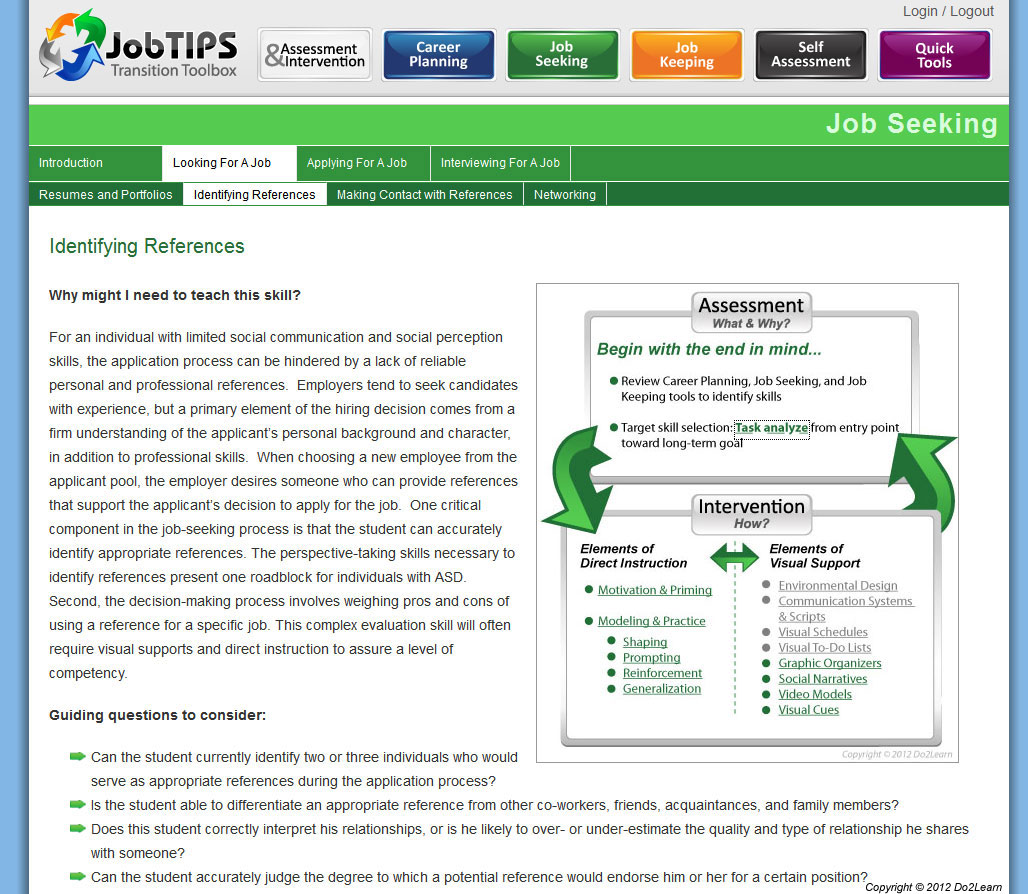
An example of what Transition Toolbox will look like.


Monday, June 4, 2012

Transition Toolbox—How Does ASD Affect Transitions?


There are a number of reasons why many individuals with Autism Spectrum Disorder (ASD) struggle to successfully transition from high school to the workforce. It may be difficult for some individuals with ASD to accurately identify how their strengths and needs align with potential vocational areas. Moreover, identifying how to apply the unique strengths of individuals with ASD within mainstream post-secondary education and work environments may pose a challenge for the transition team as well.

In addition, differences in social communication skills can make job situations difficult for someone on the spectrum. Interviewing, talking to a supervisor, making small talk with co-workers, and asking for help can be challenging. Because social rules and norms do not always come naturally to individuals with ASD, the process of getting a job and sustaining employment can be very confusing. Coping with stress and anxiety in the workplace is crucial to success yet often a major challenge for individuals with ASD.

The range of vocational abilities, of interaction skills, and of cognitive problem-solving skills in individuals with a diagnosis of ASD is remarkably broad. Yet there are certain common elements that, if carefully considered, can support effective transition planning even in this diverse group of learners. These common elements, or core features, are pivotal in how the Transition Toolbox is organized and presented. Depending on the individual with ASD, certain core features will be more prominent than others.
(We invite you to follow our blog by email to be sure to get the latest information regarding JobTIPS Transition Toolbox and other great Do2Learn educational information.)

It is important to understand the core features that have a significant impact on the transition process. We will address these core features in future Transition Toolbox blogs.


Tuesday, May 22, 2012

Transition Toolbox—Transition 101


Transition services as defined by the Individuals with Disabilities Education Act (IDEA) are intended to help youth with disabilities make the transition from the world of secondary school to the world of adulthood. A good transition plan should consider the individual’s strengths as well as needs in determining the best fit for the individual in terms of vocation, living arrangements, post-secondary education, etc.
It is important to understand that when the individual leaves public secondary school, the Americans with Disabilities Act (ADA), not IDEA, becomes the law that guides access to rights and services for the adult. Inherent in ADA is the expectation that the individual will advocate for his/her own needs.
  • Can s/he evaluate and state his/her strengths and preferences?
  • Should s/he disclose anything about his unique learning and performance needs? 
  • Can s/he effectively self-disclose about his needs and define accommodations that will enhance his/her performance in post-secondary education and work?
  • Do the parents and the student recognize the importance of self-advocacy in post-secondary education and work?

Because of this law, it is crucial that the secondary educational program promotes the capacity for self-determination in the individual, supports the individual in self-identifying strengths and preferences, and helps the individual define accommodations and needs that will help him/her succeed in the adult community. 
(We invite you to follow our blog by email to be sure to get the latest information regarding JobTIPS Transition Toolbox and other great Do2Learn educational information.)
Previous Transition Toolbox blogs from Do2Learn.

Transition Toolbox—What's the Plan?


Friday, May 11, 2012

Transition Toolbox—Where Do We Start?


Transition planning is a methodical process that defines the core skills that will be priorities during a student's transition years of school. Transition planning requires that the transition team selects core skills on which the student can build a career and a meaningful life. Students with Autism Spectrum Disorder (ASD) continue to develop life and work skills throughout their lives so the goal is to define those core skills that will be a foundation for future success. Prioritizing these goals requires thoughtful assessment and planning as well as the recognition that the transition years only set the stage for future skill development, self-advocacy and career opportunities.

Because schools are setting the student's stage for a career, effective transition planning must be based on the individual needs, strengths and interests of each student. Individuals with disabilities who are served in special education are eligible for a free and appropriate education up to 21 years of age, or older in some states. During their high school years, extensive planning for the transition out of school and into the next phase of their lives should take place. This planning must begin very early in high school to assure that all of the process is completed.

If an individual is going on to post-secondary education or into the competitive work force, there are critical areas of instruction that must be addressed within the presentation of the standard course of study in high school. These areas include:

  • Specific job skills (vocational skills)
  • Social communication
  • Work behaviors
  • Social problem solving
  • Self-organization necessary for finding and keeping a job

Transition Planning must start very early in high school.

Transition Toolbox—What's the Plan?


Thursday, April 26, 2012

Transition Toolbox—What's the Plan?


Do2Learn's JobTIPS Transition Toolbox will be a huge help to transition teams and educators as they ponder the following challenging questions that arise for students who have Autism Spectrum Disorder (ASD).

  • How can educators best prepare students with Autism Spectrum Disorder for post-secondary educational and work environments?
  • How can a transition team take optimal advantage of the unique interests and strengths of students of ASD?
  • While addressing the standard course of study how can the transition team support the goals of self-advocacy, judgment, and social integration in ways that meet the goals of IDEA?
  • How can educators apply ASD intervention practices that have been identified as evidence-based to transition programming in an integrated fashion?

The JobTIPS Transition Toolbox intends in five units to help transition teams answer these challenging questions.

Of course the answers to these questions, vary greatly depending on the individual with ASD. One thing that we know for certain, is that the move from school environments into adult residential, vocational and community environments is a very challenging transition. This transition can take much time beyond the end of high school to get to meaningful and fulfilling routines in all three areas. Both residential competence and community integration are important areas of focus in transition planning.

More to come, so stay tuned!


Transition Toolbox--Do2Learn Does It Again 


Monday, April 16, 2012

Transition Toolbox--Do2Learn Does It Again


Once again Do2Learn has put together a team of educational and clinical experts to design a new program to meet the challenge of workforce preparation for students with Autism Spectrum Disorder (ASD). This team is putting the final touches on the this program and getting it ready for release, but they want to let the public know what they can expect from the JobTIPS Transition Toolbox. So, in the next few weeks and months you will see several blogs that will address what Transition Toolbox will be offering. To make sure that you don't miss any important announcements, go ahead and subscribe to this blog by entering your email address in the “follow by email” box to your right and below our popular posts.

Who needs to follow the Transition Toolbox blogs?
  • High School Educators
  • High School Administrators
  • Vocational Rehabilitation staff
  • Transition Coordinators
  • Advocacy and Training Organizations
  • Professional Clinicians
  • Job Coaches
  • Parents

Who will Transition Toolbox serve?
  • High school students with ASD who are post-secondary (college, tech school, etc.) or job bound who participate in the standard course of study and/or spend the majority of their day in the regular education setting.

So what's stopping you? Sign up now so that you won't miss out on all the information that is heading your way about Transition Toolbox!


Transition Toolbox—What's the Plan?


Sunday, February 26, 2012

ASNC and Do2Learn Partner—JobTIPS


In the Winter 2012 Edition of the Autism Society of North Carolina's (ASNC) magazine, The Spectrum, there is a wonderful article about a collaboration between the Training Department at ASNC and Do2Learn with the JobTIPS program. The initial group consisted of five individuals and two facilitators. Please read the entire article for more information about the vocational training group on page 17 of The Spectrum.

JobTIPS is designed to help individuals with disabilities such as Autism Spectrum Disorder explore career interests, seek and obtain employment, and successfully maintain employment. It also addresses the social and behavioral differences that might make identifying and keeping a job more difficult. Do2Learn offers JobTips FREE and the program is designed for direct use by the individual. Often it is more suitable to have someone else go through the program with the individual such as a job coach, parent, teacher, etc. Having this guidance may add structure to the program and having someone there to answer any questions right away is always helpful.

To assist those helping someone going through the JobTIPS program, Do2Learn has a comprehensive tutorial page complete with a step-by-step guide to assist in navigating the website.

For example the explanation of the toolbar:


The main toolbar on the left shows you all the major topics discussed on the website. You can use your mouse to scroll down to the topic you are interested in. If the title becomes highlighted when the cursor is over it, click on it. Most topics have a sidebar that appears the the right, showing the subtopics within that section. Use your mouse to scroll over the subtopic you are interested in and click on the highlighted title to go to that webpage.

The JobTIPS tutorial page further explains in detail videos, tip boxes, printables, key points, why boxes, and navigation arrows. This page is a good place to start when beginning the JobTIPS program for a successful navigation experience.

Do2Learn is committed to assisting those with Autism Spectrum Disorder in finding appropriate employment opportunities. Look for Transition Toolbox coming soon!