Pages

Showing posts with label Autism and Vocational Rehab. Show all posts

Thursday, August 2, 2012

Transition Toolbox—Why You Need It


JobTips Transition Toolbox is soon to be released! We have spent months sharing insight into how Do2Learn and it's team of wonderful professionals have built this fantastic web-based curriculum. Now we are going to share some facts about how Transition Toolbox is needed in your school district, county, system, etc.

These are facts that can be used when you go to administration to let them know how EVERYONE in your school system (students, teachers, administration, etc.) will benefit from utilizing Transition Toolbox.
  • 1 in 88 individuals in the U.S. are now diagnosed with an Autism Spectrum Disorder
  • As of Fall 2011, there were about 370,000 U.S. Special Education students ages 6-21 identified for Special Education in the Autism category
  • From 1997-2006 (this is the most recent federal data available), autism was one of only two disability areas (2 out of 14) where there was a significant increase in the number of students served under that disability category. U.S. Department of Education reports that Autism is the fastest-growing developmental disability category.
  • From 1997-2006, there has been a significant increase on the number of students identified as having Autism in the U.S. who graduated with a regular high school diploma (33.6% increased to 57.1%).
  • Approximately 50,000 adolescents with ASD will be turning 18 this year (2012).
  • The number of individuals with Autism who were served by Vocational Rehabilitation (VR) in the U.S. has increased substantially. For example, between 2002-2006, the number of consumers with Autism increased by 121%.
  • When individuals with Autism served by VR were compared to persons with other conditions, on a per capita basis, individuals with Autism are among the most costly to serve.
  • Up to 90% of job losses in individuals with disabilities are due to problems within occupational soft skills areas such as social communication and self-regulation.
  • Youth with an ASD seem to be uniquely at risk for negative post-school outcomes, as compared to those with other types of disabilities. While only 55% of those with an ASD are employed in the six years beyond high school, 86% of those with a speech or language impairment, 94% of those with a learning disability, and 69% of those with an intellectual disability have found employment.
  • There are interventions for those with ASD that have been identified as “best practice” and “evidence-based practices”. These have been identified by the National Autism Center and the National Research Council. Some of these practices are also identified as evidence-based interventions for individuals with other learning needs (e.g. intellectual disability, emotional disability).
  • Transition Planning, as mandated by the Individuals with Disabilities Education Act (IDEA), is designed to be within a results-oriented process, that is focused on improving the academic and functional achievement of the individual with a disability to facilitate the individual's movement from school to post-school activities, including vocational education, integrated employment (including supported employment), etc.
  • Students who graduate with a regular high school diploma follow the Standard Course of Study/the Common Core State Standards. Within the curriculum, we have identified explicit links between the majority of our intervention topics and specific curriculum standards.
So take time to review our previous blogs look at how Transition Toolbox will assist you and your students with Autism in preparing for success after high school!


Tuesday, July 24, 2012

Transition Toolbox—An Employment Preparation Curriculum


We have been talking about the JobTips Transition Toolbox for several weeks and the time is drawing near for it's release in the Fall of 2012. I want to take this time to give readers a good overview of what they can expect from TT.

This web-based curriculum is designed to support students with Autism Spectrum Disorder and other learning differences who are bound for post-secondary settings or competitive employment upon graduation from high school. It is also appropriate for use with adults with such differences who struggle to obtain fulfilling and lasting competitive employment. The curriculum targets 61 intervention topics and offers approximately 450 printable visual supports, along with 87 self-assessments and instructor assessments.

  • Unit 1 Assessment and Intervention: Our framework in teaching the intervention topics identified in the Career Planning, Job Seeking, and Job Keeping curriculum units that represents the integration of evidence-based behavioral strategies and visual supports. There are 18 sections that comprehensively address these instructional principles and strategies.

  • Unit 2 Career Planning: Contains 6 expansive intervention topics describing a range of specific work skills (“hard skills”) that the instructor might target in career development and emphasizes the importance of an experientially-based exploration of vocational interests as a means to support self-assessment. This unit offers over 50 printable visual supports and 35 printable self-assessments and instructor assessments.

  • Unit 3 Job Seeking: Contains 15 intervention topics targeting a range of skills and activities necessary to find and get a job. This unit includes over 100 printable visual supports, dozens of video scenarios and video modeling examples, and 20 printable self-assessments and instructor assessments.

  • Unit 4 Job Keeping: Contains 40 intervention topics. This unit addresses the principle challenges of Social Communication, Organization, and Self-Regulation (S.O.S.!) that often impact one’s ability to maintain employment. This unit provides over 300 printable visual supports, dozens of video scenarios and video modeling examples, and 32 printable self-assessments and instructor assessments.

  • Unit 5 Self-Assessment Library: Houses the 87 printable student self-assessments and instructor assessments that align with all topics within Career Planning, Job Seeking, and Job Keeping units.

Please look over our past Transition Toolbox blogs for more specific information about the “nuts and bolts” of the make up of the curriculum. We will be bringing you more information as we get closer to the release date, including a detailed sneak-peek for our blog readers!

STAY TUNED!


Tuesday, June 12, 2012

Transition Toolbox—Organization & Central Coherence


In Do2Learn's blog, Transition Toolbox—How Does ASD Affect Transitions?, we told you we would be addressing core features that have a significant impact on the transition process. Today we will discuss organization and central coherence. We hope that allowing these peeks into our new product are peaking your interest!

Some individuals with Autism Spectrum Disorder (ASD) show significant difficulty with sequential organization and planning of multi-step tasks. Shifting of focus to use new or unexpected information in a task may pose a problem for some. Many seem to process information in a limited set of categories and struggle to integrate new information into existing mental frameworks. This has led to a theory of central coherence suggesting that many individuals with ASD have difficulty seeing the ‘big picture.’ New information, especially around meaning, context, and social interaction, can be missed or misinterpreted. Generalization of skills is a consistent challenge for many individuals with ASD. This difficulty applying skills previously learned under one condition to new conditions implies problems shifting focus and using a concept or rule when certain features of a setting or condition change.
There continues to be controversy confirming a central coherence deficit as a primary descriptor of ASD. A less debatable observation is that certain individuals with ASD have difficulty deciding how to use new information in social and cognitive problem-solving situations. For an individual with ASD, figuring out what a new event means and how to ‘fit’ it into life can be confusing. These common difficulties for individuals with ASD in assessing new information, in weighing the ‘pros’ and cons’ in decision making, and in planning the steps to complete a task require transition team members to adjust their thinking. If individuals with ASD have problems assessing how to apply their strengths and weaknesses in vocational and social situations, in determining their goals or in planning a course of action, there will be challenges in self-determination and self-advocacy.
In transition planning, the prominence of inventory assessments to evaluate strengths and interests is obvious. Yet the difficulties related to organization and central coherence often make inventory assessments absurdly ineffective in identifying directions for transition planning for individuals with ASD. Assessments of preferences and strengths related to career goals must be individualized.
Building self-determination skills is feasible and important.
  • First, provide multiple experiences in vocational and community environments. Without the opportunity to practice and experience work activities, work environments, and the social contexts of those work settings, individuals with ASD may confront failure or frustration in future settings.

  • Second, provide visual supports to help the individual self-evaluate and compare experiences so that the individual can define preferences and self-advocate to the highest degree possible. These visual supports should be provided within a systematic framework of direct instruction, using established behavioral principles, that assures application and generalization of skills.
  • Providing opportunities for hands-on exploration of work and academic experience must be followed by individualized and systematic self-assessment of the experience to support self-advocacy in career planning.
To address cognitive differences in ASD and to assist self-determination, the instructor must provide multiple experiences and visual supports provided within a framework of direct instruction. This is one primary goal of the JobTIPS Transition Toolbox.
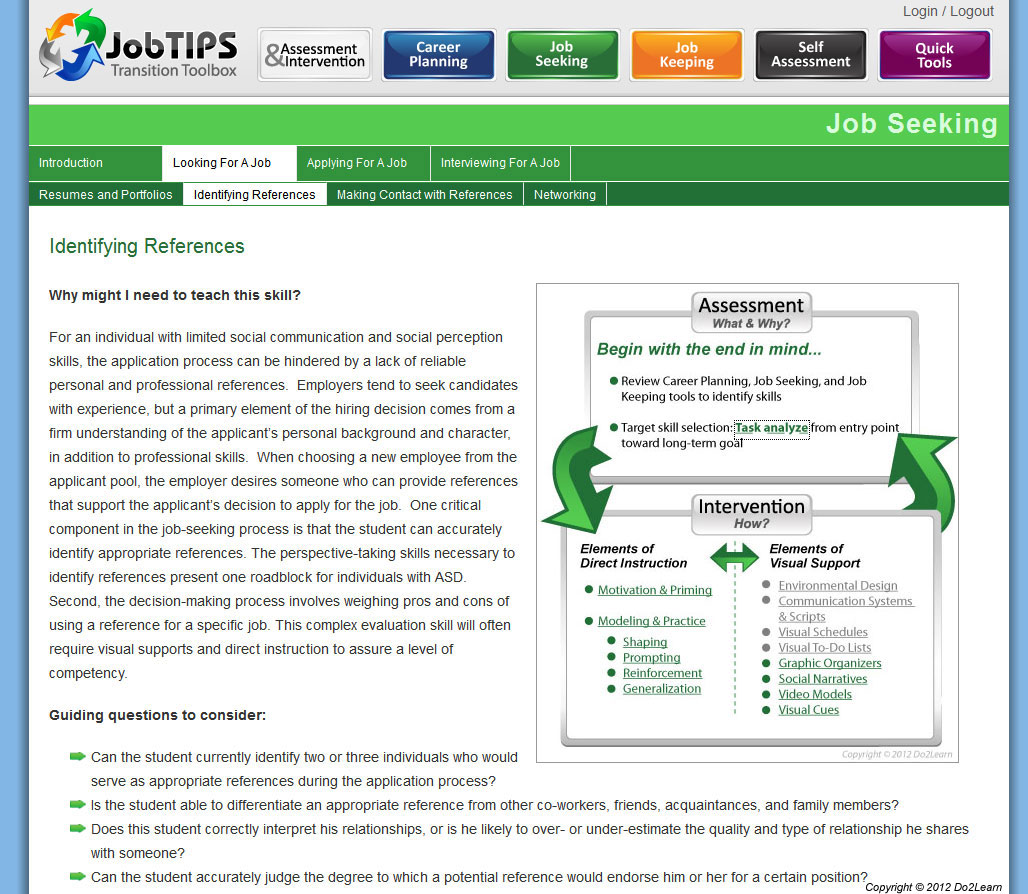
An example of what Transition Toolbox will look like.


Thursday, April 26, 2012

Transition Toolbox—What's the Plan?


Do2Learn's JobTIPS Transition Toolbox will be a huge help to transition teams and educators as they ponder the following challenging questions that arise for students who have Autism Spectrum Disorder (ASD).

  • How can educators best prepare students with Autism Spectrum Disorder for post-secondary educational and work environments?
  • How can a transition team take optimal advantage of the unique interests and strengths of students of ASD?
  • While addressing the standard course of study how can the transition team support the goals of self-advocacy, judgment, and social integration in ways that meet the goals of IDEA?
  • How can educators apply ASD intervention practices that have been identified as evidence-based to transition programming in an integrated fashion?

The JobTIPS Transition Toolbox intends in five units to help transition teams answer these challenging questions.

Of course the answers to these questions, vary greatly depending on the individual with ASD. One thing that we know for certain, is that the move from school environments into adult residential, vocational and community environments is a very challenging transition. This transition can take much time beyond the end of high school to get to meaningful and fulfilling routines in all three areas. Both residential competence and community integration are important areas of focus in transition planning.

More to come, so stay tuned!


Transition Toolbox--Do2Learn Does It Again