Pages

Sunday, July 15, 2012

Homework Tips for Home Use


A few days ago we were talking about back-to-school in our blog. Today we are going to talk about homework. Yep, that dreaded time of day for all parents and students that can often lead to tears and stress for both. There is a better way though and Do2Learn has some tips to get you through it.

All students, special needs or not, are reluctant to do homework. For those students who do have special needs these issues can be magnified. These reasons include:

  • Fatigue at the end of a long school day
  • Frustration caused by not understanding the assignment
  • Forgetting the materials needed to complete the assignment
  • Assignments that are too difficult
  • Competing interests such as video games and computers
  • Over-schedule with after school activities
  • Emotional and behavioral issues

First and foremost, please parents and caregivers, communicate any homework difficulties that your child is having at home with the teacher! If homework is becoming a struggle that could be many issues that could be impacting the situation and together you and the teacher/s can work together to analyze and make suggestions accordingly.

Here is a list of other suggestions that can assist in helping make homework time go smoother.

  • Keep a class list that the student can call if they forget their homework. Have the student exchange contact information with a peer so they can call if they need help or information about homework assignments or classroom events. For those with social issues that would complicate this (autism) perhaps having it written into the IEP to have the teacher write the homework assignment for the student or check that the student wrote it correctly.
  • Keep materials such as paper, sharpened pencils, calculators, rulers, and other tools in an accessible location. This will help with organization. For students with an IEP, requesting an extra set of books for home will eliminate forgetting to bring books home or taking them back to school.
  • Establish a homework time to help the student develop efficient study habits.
  • Set boundaries with the child about the amount of help they receive. Sometimes children will rely on adult assistance to complete tasks that they can do independently. Allocate a certain number of problems that the child must do before checking in with an adult.
  • If the student needs breaks – use sand timers or analogue clocks to help monitor the work time. (click link for more info)
  • Have the student take a quick active break before starting again, such as 10 baskets or riding their bike around the block twice.
  • Before going to bed, have the student pack their book bag and set it in an obvious location so they will not forget it the next day.


Saturday, July 14, 2012

Transition Toolbox—Self Determination by Beginning with the End in Mind


The JobTIPS Transition Toolbox provides a set of assessment instruments and intervention activities that support self-determination in career planning, job-seeking, and job-keeping skills for students who are either job bound or post-secondary education bound after high school. The focus of the Toolbox is independence in vocational and educational environments.

Given that there are often more priorities in preparing for adulthood than can reasonably be addressed by school staff alone, this task of prioritizing is a challenge for IEP teams that must address transition planning. When all members of the team come together to plan an IEP, one goal is to list the various needs. When prioritizing, it is worthwhile to consider that the school environment is only one environment for learning and applying vocational, residential, and community skills. In looking at the big picture in transition planning, there will be ‘instructional goals’ on which the teaching team will focus to support application of specific targeted skills. There should also be ‘linkage goals,’ targets that other members of the larger support team, including family, friends, volunteer supports and other community support personnel, would address in environments other than the school. The IEP team must determine which priorities should be addressed as instructional goals. The Transition Toolbox will help the instructor to determine those instructional goals, those prioritized skills on which the individual with ASD and his circle of support can build the broad range of skills to have a successful vocational career.

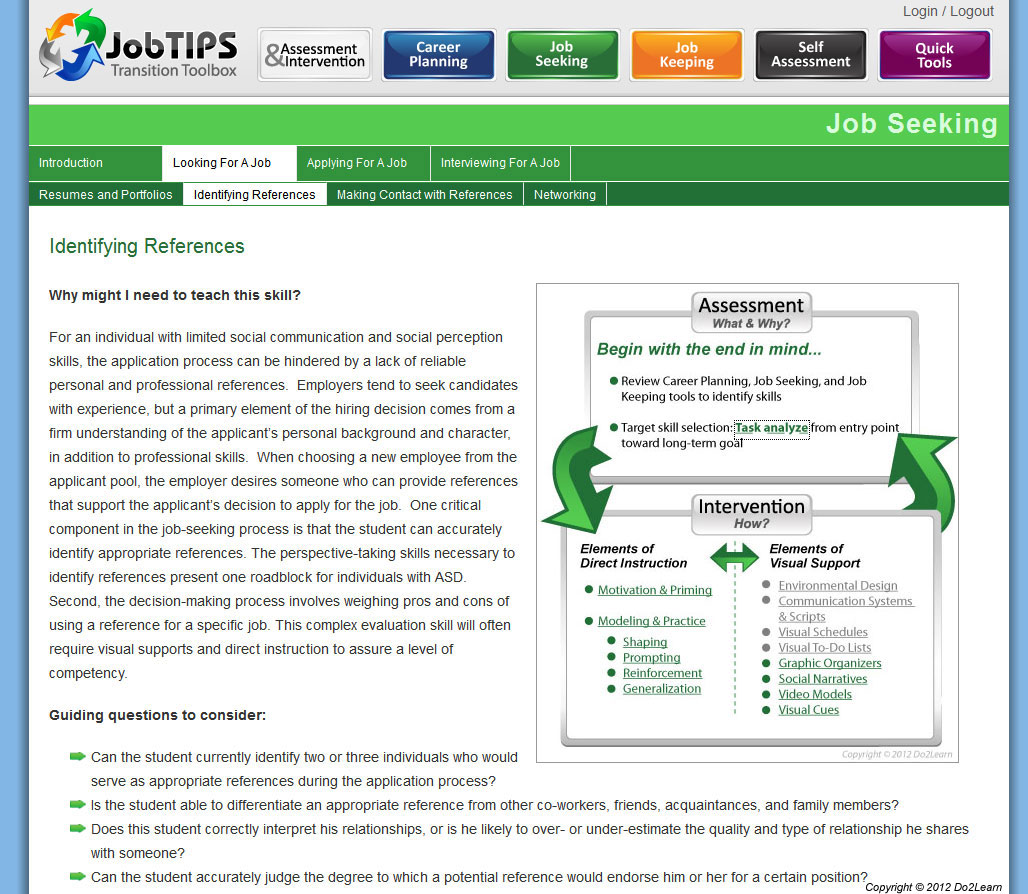
The user is encouraged to use Assessment & Intervention (A&I) as a framework in teaching the skills identified in the curriculum units. Each of the curriculum units provide both a detailed description of possible skills and goals for the student and an adjustable self-assessment instrument to support self-determination in skill development. The strategies (identified in Assessment and Intervention) necessary to build independent skills are multiple and often layered. No single strategy is often sufficiently strong to support independent performance. In addressing specific goals in each curriculum unit, a combination of environmental modification, priming, motivation, visual supports, modeling, prompting, shaping, reinforcement, and programming for generalization is required to build successful independence.

As an instructor working to cultivate the capacity for self-determination within your students as they approach the transition out of high school, where do you begin? You begin with the end in mind. These four units engage you in a systematic instructional process of targeting skills that are essential to your student’s current and future success:

  • Career Planning: This unit describes a range of specific work skills to consider in career development and emphasizes the importance of an experientially-based exploration of vocational interests as a means to support self-assessment.
  • Job-Seeking Skills: This unit describes the range of skills necessary to actually find and get a job.
  • Job-Keeping Skills: This unit addresses the principle challenges of Social Communication, Organization, and Self-Regulation (S.O.S.!) that often impact one’s ability to maintain employment. It describes the range of often challenging work behaviors that can and should be addressed in job exploration and training.
  • Self-Assessment: We strongly encourage you to begin with the Assessment & Intervention Unit (A&I) , as it is the framework in teaching the skills identified in the curriculum units.


Wednesday, July 11, 2012

Back To School Prep


It seems like Summer is barely halfway over for some, but others are already back in class. Now is the time to begin to prepare for sending your child back to school. That means more than just buying those all important school supplies that teachers are always so thankful for and need so much.

You may want to write a social story about what your child can expect in a school day. Read this story daily and make it exciting and fun! Be sure to include the following:
  • When bedtime will be on nights before going to school
  • What time they will have to get up on school mornings
  • How will they get to and from school
  • Will there be before or after school care
  • Any other details that you think may relieve anxiety
  • BUT be careful and don't add details that you are not sure of, because you know that your child will hold you to the story, so be sure to leave yourself some room for changes as they can happen.
Make some visits to the school and become familiar with the building and grounds if this is a new school. Even if it's not a new school, children are very reassured to know that this will be the same school that they went to last year and to be able to see it before there are lots of other people and noise can be very reassuring and lessen anxiety on those first few days.

Also, to assist in transitioning from home to school in the mornings, using a picture or written schedule can lessen anxiety for children and parents. Beginning the use of the schedule way before school will have both used to it and mornings will go smoothly.

With the picture schedule the activities are checked off as they are completed.

Written schedules can hold more complex information for more advanced readers.

For more detailed information on how to utilize these schedules and for blank forms and free printable picture cards please visit our site here.


Monday, June 25, 2012

Let's Organize a Pre-K Classroom


Organize, organize, organize! The key word in teaching all children, but particularly those with Autism and as we know early education is very important. So let's take a peek at a pre-k classroom set-up that is very successful. We know that teachers are not given a lot of space, so being organized is very important and visually organizing the space is even more important to giving the ASD student clues as to what is expected of them in that space. We will refer to this as Jane's classroom and there is a permanent link with more information for you.

There are lots of separate areas within Jane's classroom to allow for students to work on different goals at the same time and then come together for group activities too.

  • In the work center the tasks are color-coded and numbered for independent learning.

  • Large and small motor skills are used in the play center.

  • The reading center is a quiet spot with bookcases and a reading rack.

  • The computer area allows two students to work at the same time.

  • At the snack/lunch table each child's chair has their name on it and they have a footstool.

  • Each child has their own space for storage. Label with their name and photo and fave color.

  • In the bathroom label baskets to organize each child's extra clothes and use picture cards to show the toileting sequence.

  • The calendar center is the perfect gathering place for all group activities.

  • At the helper center each child has a name card that is placed beside a helping task.


For more detailed information check out Jane's classroom. We hope you get some great ideas for setting up your classroom!!

Wednesday, June 20, 2012

Transition Toolbox—Theory of Mind and Perspective-Taking


As we discussed in our past two blogs regarding Transition Toolbox and Transition Planning (Transition Toolbox—How Does ASD Affect Transitions? and Transition Toolbox—Organization & Central Coherence) we are continuing to address core features that have a significant impact on individuals with Autism Spectrum Disorder (ASD) and the transition process.

There are significant differences for individuals with ASD in understanding facial expressions, body language, actions, and words to determine another person’s thoughts or perspective. Our ‘social world’ values the skill of recognizing another person’s thoughts and actions and using that information in leisure and work activities. Acting considerately towards customers is but one example of how theory of mind and perspective taking is expected within work environments. An inability to recognize the behavior of co-workers and to adapt personal behavior often leads to misunderstanding and to the opinion that the individual with ASD is rude or hurtful. In our culture, getting along with co-workers and supervisors are required behaviors to be successful on the job.
Picking out the important social details in an interaction, and adjusting personal behavior as a result, are the skills of social problem-solving. Individuals with ASD may not see the importance of adjusting personal behavior, may not know what to do instead, or may not remember what to do when the social situation arises that requires the adjusted social behavior.
Individuals with ASD need systematic practice in applying specific social communication skills in multiple settings. The JobTIPS Transition Toolbox provides multiple tools to address these social issues as they impact one’s efforts to find and keep a job. Specific social communication goals are outlined in the Job-Seeking Unit and the Job-Keeping Unit. Specific instructional strategies and hands-on visual supports to assist practice of social communication skills are provided. Also, the tools within the Self-Assessment Unit may assist the individual in identifying areas of improvement and determining social aspects of work environments that may better fit the individual.


Thursday, June 14, 2012

Autism and Trying New Things


Does the title of this blog send you running for the hills at the thought of introducing something new into your child or student's life. It could be as simple (to you) as switching from the blue crayon to a red one or as complex as going through the grocery store in a different pattern. You know that what can be a simple “trying of something” for some kids is simply not that easy when an individual has Autism Spectrum Disorder.
Structure and organization, patience and time! They are our best friends in easing the anxiety in individuals with ASD and trying new things. The anxiety these individuals feel can limit their knowledge about their world and opportunities to find things they enjoy. So if we structure these experiences through planning and preparation, we can help ease anxiety and set up the situation for success.
  • Trying New Things Story—Use this as you would a social story. Individualize it to the situation and the person, then review it often well in advance of the planned “new experience”.
  • Select the new thing to plan and prepare for.
  • Complete the Circle form graphic organizer to lay out the steps (see below)
  • Follow the plan in the Circle Form

Check here for more information on "Trying New Things".  Have fun trying new things and we wish you much success!  


Tuesday, June 12, 2012

Transition Toolbox—Organization & Central Coherence


In Do2Learn's blog, Transition Toolbox—How Does ASD Affect Transitions?, we told you we would be addressing core features that have a significant impact on the transition process. Today we will discuss organization and central coherence. We hope that allowing these peeks into our new product are peaking your interest!

Some individuals with Autism Spectrum Disorder (ASD) show significant difficulty with sequential organization and planning of multi-step tasks. Shifting of focus to use new or unexpected information in a task may pose a problem for some. Many seem to process information in a limited set of categories and struggle to integrate new information into existing mental frameworks. This has led to a theory of central coherence suggesting that many individuals with ASD have difficulty seeing the ‘big picture.’ New information, especially around meaning, context, and social interaction, can be missed or misinterpreted. Generalization of skills is a consistent challenge for many individuals with ASD. This difficulty applying skills previously learned under one condition to new conditions implies problems shifting focus and using a concept or rule when certain features of a setting or condition change.
There continues to be controversy confirming a central coherence deficit as a primary descriptor of ASD. A less debatable observation is that certain individuals with ASD have difficulty deciding how to use new information in social and cognitive problem-solving situations. For an individual with ASD, figuring out what a new event means and how to ‘fit’ it into life can be confusing. These common difficulties for individuals with ASD in assessing new information, in weighing the ‘pros’ and cons’ in decision making, and in planning the steps to complete a task require transition team members to adjust their thinking. If individuals with ASD have problems assessing how to apply their strengths and weaknesses in vocational and social situations, in determining their goals or in planning a course of action, there will be challenges in self-determination and self-advocacy.
In transition planning, the prominence of inventory assessments to evaluate strengths and interests is obvious. Yet the difficulties related to organization and central coherence often make inventory assessments absurdly ineffective in identifying directions for transition planning for individuals with ASD. Assessments of preferences and strengths related to career goals must be individualized.
Building self-determination skills is feasible and important.
  • First, provide multiple experiences in vocational and community environments. Without the opportunity to practice and experience work activities, work environments, and the social contexts of those work settings, individuals with ASD may confront failure or frustration in future settings.

  • Second, provide visual supports to help the individual self-evaluate and compare experiences so that the individual can define preferences and self-advocate to the highest degree possible. These visual supports should be provided within a systematic framework of direct instruction, using established behavioral principles, that assures application and generalization of skills.
  • Providing opportunities for hands-on exploration of work and academic experience must be followed by individualized and systematic self-assessment of the experience to support self-advocacy in career planning.
To address cognitive differences in ASD and to assist self-determination, the instructor must provide multiple experiences and visual supports provided within a framework of direct instruction. This is one primary goal of the JobTIPS Transition Toolbox.
An example of what Transition Toolbox will look like.


Sunday, June 10, 2012

It Is About What You Learn In Kindergarten


Yesterday we celebrated the graduation of one of Kaitlin's friends from High School. WTG class of 2012!

What was so special about this celebration was that it was a gathering of teachers, parents, and friends who had all started out together in preschool/kindergarten. The graduate himself requested this. Yes, he has Autism, but let me assure you that is just an aside, because having Autism has never once gotten in his way of achieving any dream or goal. So the goal for this gathering was a reunion of sorts and thankfully all the pieces fell into place. Oh, guess what...you know all those stories about individuals with Autism not being social? Umm, well, I think if you had been with us yesterday you would have seen those stories completely dispelled! In fact it may not have been much different from any other gathering you might have peeked in on. I take that back, it would have been a lot more fun and you would have felt much more comfortable. Here are some snippets of conversation you would have heard...
  • “Miss Kat can you do those windshield wipers like you used to do in bus loop when we were little?”
  • “Can you believe we both used to wear Harry Potter glasses?”
  • “Oh no, Miss Laurie and Miss Carolyn didn't just take us on a train. We went all the way to Rocky Mount!”
  • “Don't worry *****,  he is on his way. I just spoke with his dad and they are almost here.” Said in response to a non-verbal individual who was communicating that he wanted to see another guest really bad.
  • “I am taking classes at Wake Tech and looking for a job. Your job sounds nice.”
  • “Make sure everyone gets some cake now and I will share my lemonade too”
  • “I graduate next year. I am going to have a party like this too, okay?”
I could go on and on, but my point is that this group of young men and women socialized together and enjoyed each others company yesterday in a way that was so typical, yet they had to work so hard to get to that point. The teachers that started this are to be applauded for all the hard work they put into these young people. Most of these young people had very little language in preschool/kindergarten and with a lot of patience, structure, and love these teachers taught these kids communication, manners, self-advocacy and more. Yep, all that in kindergarten! All with shapes, stories, songs, snacks, dances, and playground time!

What you learn in kindergarten makes a HUGE difference, so make it count!!
June 9th 2012


Wednesday, June 6, 2012

Making Your Life Easier—Checklists, Calendars, and Forms


Having structure in your child/student's life makes your life easier! You know it, I know it and we covered it in our blog A Schedule? She's Two back in January 2012. What you may not know is that Do2Learn has free printable resources available to you.

I recommend that you print off copies of the ones you find the most useful and keep them handy so you can fill them in as needed. Of course you can save them on your computer and fill them in with text or pictures and then print, but sometimes plain old fashioned handwriting works best and is quickest. These forms are just a few of the ones that are utilized in Do2Learn's Make-A-Schedule Program.

  • Daily form with 10 lines—10 activities can written and then checked off or a sticker earned as each one is completed.
  • 1 inch daily form—this is really good as a homework chart
  • 1 inch weekly form—this form can have a picture or activity listed down the side and then checked off or a sticker earned and used for one week.

  • weekly form with 10 lines—this form is helpful in keeping users organized and independent for a whole week.
  • weekly form with 20 lines—this form offers more room and can be used in the same way as the above form for chores, homework, etc.
  • calendar form—the calendar allows for more forward planning and keeping track of long term assignments, appointments, vacation days, etc.
  • 1 inch blank form—make your own schedule
  • 2 inch blank form—make your own schedule using larger images
We would love to hear how you find these organizational forms helpful! Drop us a line.


Monday, June 4, 2012

Transition Toolbox—How Does ASD Affect Transitions?


There are a number of reasons why many individuals with Autism Spectrum Disorder (ASD) struggle to successfully transition from high school to the workforce. It may be difficult for some individuals with ASD to accurately identify how their strengths and needs align with potential vocational areas. Moreover, identifying how to apply the unique strengths of individuals with ASD within mainstream post-secondary education and work environments may pose a challenge for the transition team as well.

In addition, differences in social communication skills can make job situations difficult for someone on the spectrum. Interviewing, talking to a supervisor, making small talk with co-workers, and asking for help can be challenging. Because social rules and norms do not always come naturally to individuals with ASD, the process of getting a job and sustaining employment can be very confusing. Coping with stress and anxiety in the workplace is crucial to success yet often a major challenge for individuals with ASD.

The range of vocational abilities, of interaction skills, and of cognitive problem-solving skills in individuals with a diagnosis of ASD is remarkably broad. Yet there are certain common elements that, if carefully considered, can support effective transition planning even in this diverse group of learners. These common elements, or core features, are pivotal in how the Transition Toolbox is organized and presented. Depending on the individual with ASD, certain core features will be more prominent than others.
(We invite you to follow our blog by email to be sure to get the latest information regarding JobTIPS Transition Toolbox and other great Do2Learn educational information.)

It is important to understand the core features that have a significant impact on the transition process. We will address these core features in future Transition Toolbox blogs.